01
Game layer
Physics, visuals, unit state. Runs on the unmodified Eagle Dynamic DCS Dedicated Server.
IASER (IAgent State Architecture for Strategy Engineering and Rebalancing) is a DCS World distribution and cluster solution that turns a stock Eagle Dynamic Dedicated Server into an autonomous battlefield. It adds a War Manager that owns economy and strategy, plus an AI offloading system that keeps the heavy compute off the DCS tick-loop.
Runs alongside
DCS World Dedicated Server is excellent at realistic flight, ballistics, damage, and per-unit state. It is not built for long-horizon AI command: grand-strategy planning, an economy that produces and consumes fuel, ammo, and funds, or a command-and-control mind that decides what to attack and when.
Running a full strategic mind inside the DCS Lua loop also stalls the sim — expensive planning blocks the tick, couples gameplay and AI, and cannot spread work across machines.
IASER fixes all three by splitting the problem into two cleanly decoupled halves joined by an asynchronous bridge.
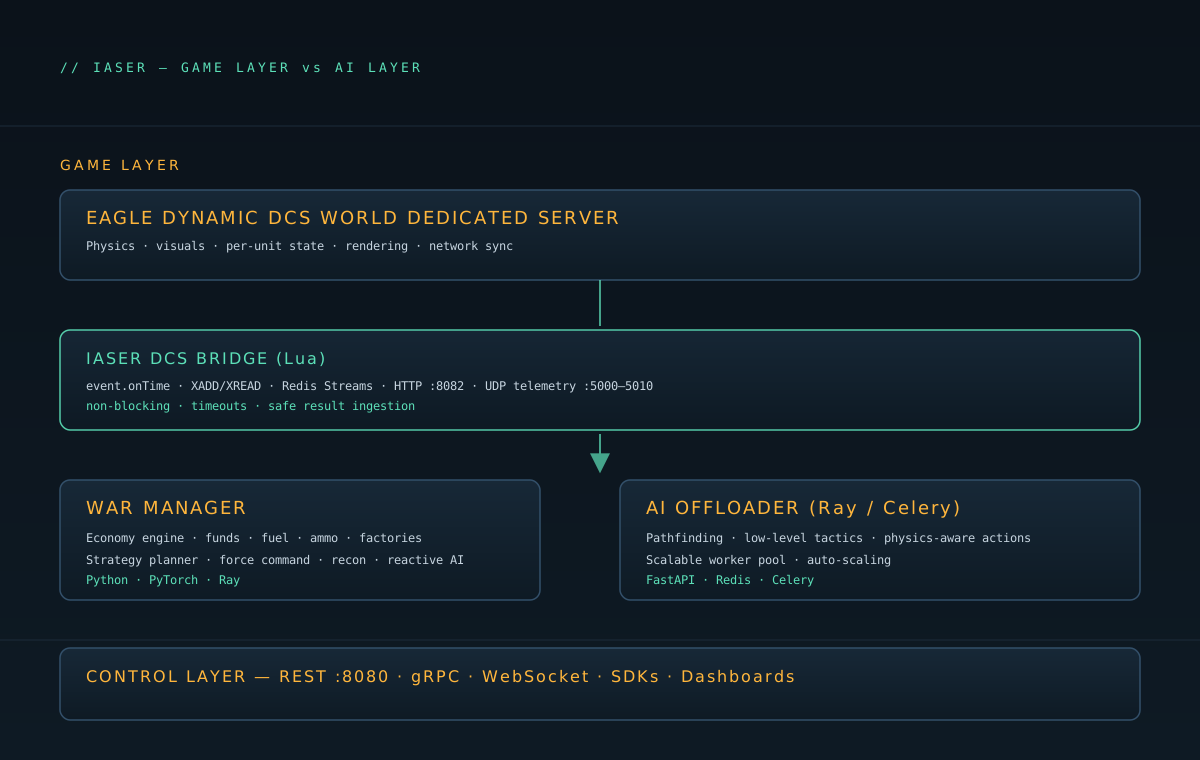
Two cleanly decoupled halves, joined by an asynchronous bridge. The game layer keeps doing what DCS does best; the AI layer does what DCS cannot.
Physics, visuals, unit state. Runs on the unmodified Eagle Dynamic DCS Dedicated Server.
Economy, strategy, command, heavy compute. Runs on a Python cluster (War Manager + offloaders).
Lua + Redis Streams. Non-blocking telemetry and control — DCS never blocks the tick-loop.
REST / gRPC API, SDKs, dashboards. Mission control, monitoring, external integrations.
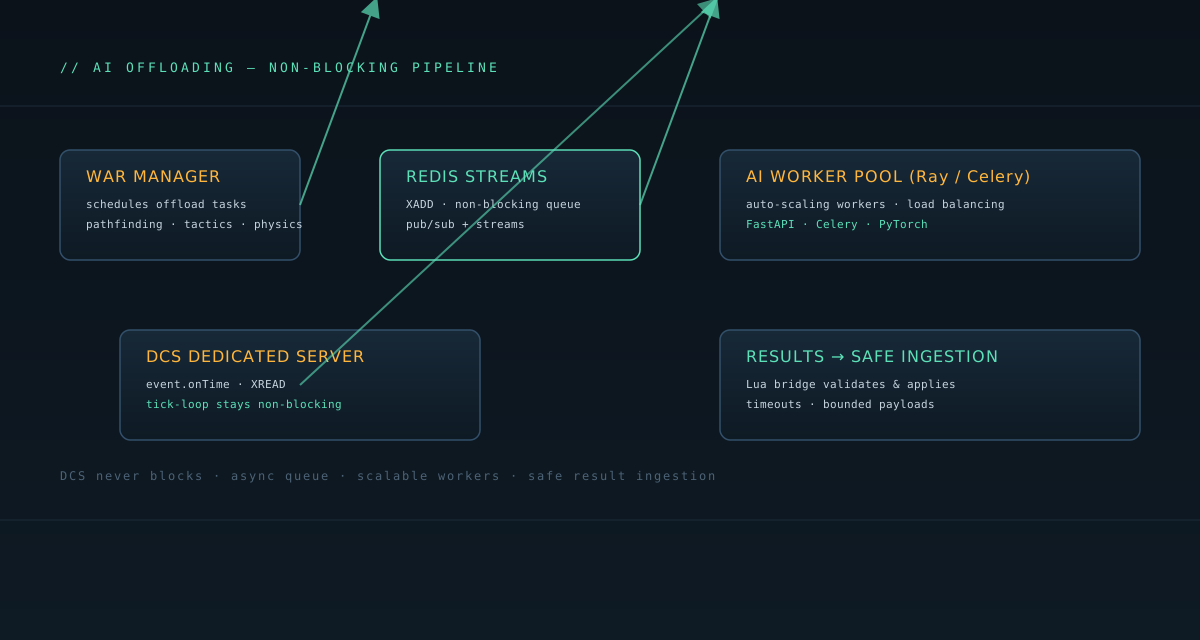
The War Manager is the Autonomous Battlefield Manager (ABM) — a Python core that commands entire theaters. It owns the economy and the strategy, and issues high-level command through a layered AI.
The planning loop runs every 10–30 seconds: recon → economy → strategy → force command → logistics.
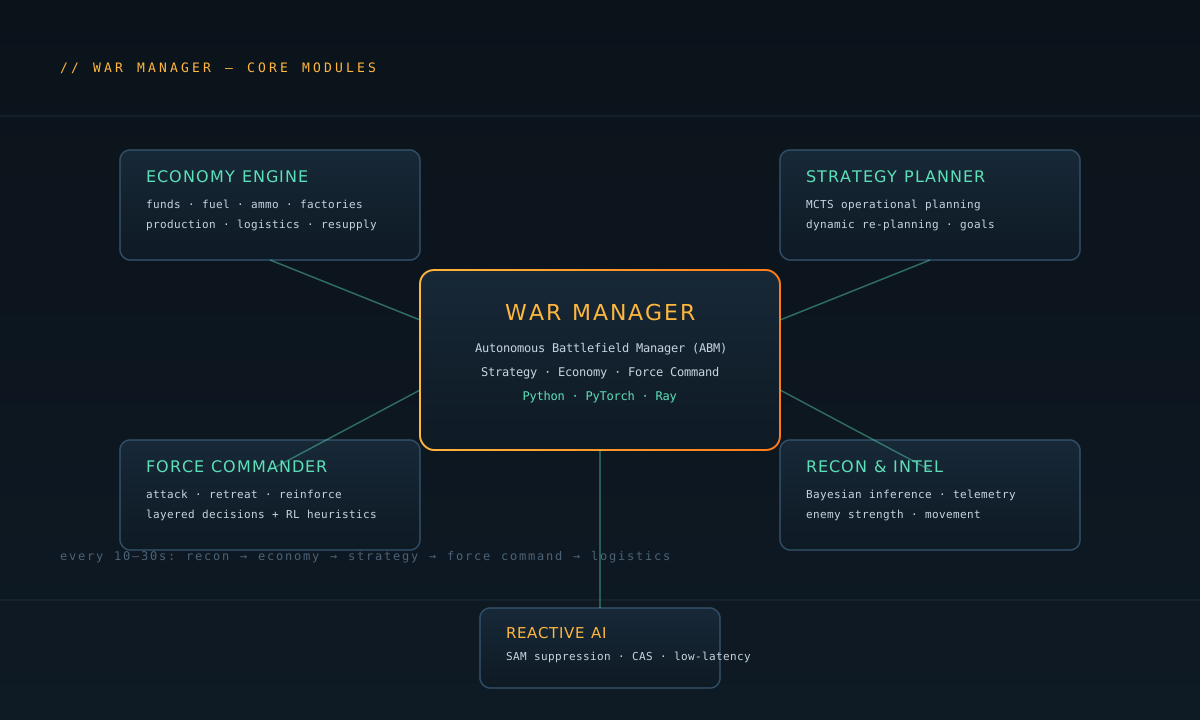
The AI offloading system is a scalable cluster of worker processes that absorb heavy computation — pathfinding, low-level tactics, physics-aware actions — off the DCS tick-loop.
Communication is non-blocking: the DCS Lua bridge pushes tasks onto a Redis Streams queue, a FastAPI + Ray / Celery worker pool crunches them, and results are ingested safely through a Lua bridge with timeouts and bounded payloads.
How IASER compares to a traditional DCS mod.
| Concern | Traditional DCS mod | IASER |
|---|---|---|
| AI Command | Scripted triggerAction, static scripts | War Manager + layered AI, dynamic re-planning |
| Economy | Manual / none | First-class engine: funds, factories, logistics |
| Strategy | None | MCTS-based operational planning with re-planning |
| Compute Load | Runs inside DCS Lua (blocks sim) | Offloaded to a cluster worker pool (non-blocking) |
| Scale | Single machine | Cluster solution, auto-scaling workers |
From the game layer up to the control layer.
DCS Dedicated Server (unmodified ED build) — physics, visuals, unit state.
War Manager (ABM core) — Python + PyTorch + Ray. Strategy, economy, high-level command.
AI Worker Pool — FastAPI + Redis + Celery. Pathfinding, low-level tactics, physics-aware actions.
DCS Bridge — Lua + Redis Streams. Asynchronous telemetry & control.
REST/gRPC API — FastAPI + Protobuf. Mission control, monitoring, external integrations.
// War Manager state schema (MongoDB / SQLite)
{
  "theater": "Caucasus",
  "factions": {
    "red": {
      "funds": 1250000,
      "factories": { "air": 3, "armor": 2, "logistics": 4 },
      "forces": [
        { "type": "Su-27", "available": 12, "deployed": 8 },
        { "type": "T-90",   "available": 40, "deployed": 24 }
      ]
    },
    "blue": { /* symmetric */ }
  },
  "missions": [
    { "id": "M-001", "type": "strike",
      "target": "Airfield 3", "status": "active" }
  ],
  "recon": {
    "enemy_air_strength": "high",
    "estimated_frontline": "lat 45.2, lon 40.1"
  }
}The full IASER specification — ten sections, thirty documents. Explore the architecture, deployment, and roadmap.
What IASER is, goals & non-goals, architecture overview, and design principles.
Read →The DCS distribution, cluster solution, Eagle Dynamic setup, mission & script pack, economy config, and telemetry wiring.
Read →War Manager overview, economy engine, strategy planner, force command, recon & intel, reactive AI, and the lifecycle loop.
Read →Offloading overview, task taxonomy, worker pool, and scheduling & load balancing.
Read →The Lua bridge, Redis Streams, event hooks, and the safety model that keeps DCS non-blocking.
Read →API overview, REST endpoints, gRPC contracts, and SDKs for external integrations.
Read →Infrastructure stack, Docker Compose, Kubernetes, and the scaling strategy.
Read →Data model, machine learning models, the telemetry pipeline, and the state store.
Read →Monitoring, observability, troubleshooting, and operational runbooks.
Read →The product roadmap, MVP phases, and the prioritized requirements backlog.
Read →Seven stages — from a documentation scaffold to a launched, monitored cluster.
Project scaffolding, docs, version control, conventions.
Freeze architecture, data model, contracts, deployment targets.
War Manager core: economy, strategy, recon, reactive AI.
Lua bridge, worker pool, end-to-end offload pipeline.
REST/gRPC API, SDKs, Docker Compose, Kubernetes.
Demo, performance, reliability, security, docs.
Release, monitor, operate, iterate.
IASER is a DCS World distribution and cluster solution by Saszel Studio. It turns a stock Eagle Dynamic Dedicated Server into an autonomous battlefield with an AI War Manager (economy + strategy) and an AI offloading system that keeps heavy compute off the DCS tick-loop.
No. IASER runs alongside an unmodified Eagle Dynamic DCS Dedicated Server. The game layer stays lean; the AI layer owns economy, strategy, and command through a lightweight, asynchronous Lua bridge.
The Saszel Framework is our custom multiplayer engine for large-scale, human-player battles. IASER is a separate product from Saszel Studio — an AI distribution that adds autonomous command, economy, and strategy to DCS Dedicated Servers. Both are built by Saszel Studio.
At this stage IASER is a documentation-first specification — the full architecture, War Manager, offloading, deployment, and roadmap are documented. Application source code is on the roadmap for later production stages.
Yes — the deployment docs cover Docker Compose for local dev and Kubernetes for production, with an auto-scaling worker pool strategy. The full specification is available in the documentation.
Dive into the full specification — architecture, War Manager, offloading, deployment, and roadmap.